How to Charge a Tesla at an RV Park with a TT-30 Outlet

TL;DR
A Tesla can charge from a suitable TT-30 outlet when the campsite permits EV charging and the owner has a Tesla Gen 2 Mobile Connector with a compatible TT-30 adapter. TT-30 is 120V/30A; a compatible setup may draw up to 24A continuously (about 2.9 kW), subject to the outlet, circuit, vehicle, and equipment. The WenStorm TT-30 adapter fits the Tesla Gen 2 Mobile Connector only. It does not fit WenStorm's fixed NEMA 14-50 portable charger or other brands' portable EVSEs. Confirm the exact pedestal and permission before booking.
Why the TT-30 Belongs in Your EV Road Trip Plan
Most EV road trip guides tell you to plan around Superchargers and DC fast chargers. They leave out an option that covers tens of thousands of locations across the US: a TT-30 outlet at some RV parks and campgrounds.
If you're spending a night at a campground, a state park, or an RV resort, confirm that your specific site has a suitable TT-30 outlet and permits EV charging before booking. A compatible Tesla Gen 2 Mobile Connector and TT-30 adapter can then provide an overnight charging option.
This guide covers what a TT-30 outlet is, exactly how fast it charges your EV, and how to plan your road trip around it.
Option 1 — Single TT-30 adapter (for known TT-30 pedestals)
Option 2 — RV Park Adapter Kit (TT-30 + 14-50 bundle)
Still not sure which is the correct fit for your car?
There Are 16,000+ RV Parks in the US — Most Have Your Outlet
The US has over 16,000 RV parks and campgrounds. The overwhelming majority are wired with the same standard power pedestal — a post mounted near each site that provides 30-amp and 50-amp shore power for RVs.
The 30-amp connection on that pedestal is a TT-30 outlet. It's the same at a KOA in Montana, a state park in Florida, a private campground in Vermont. Confirm the specific outlet, pedestal condition, and campground EV-charging policy before relying on a site.
This is the most underused road trip charging strategy for EV owners — especially for Tesla Gen 2 mobile connector owners who already carry their charging hardware in the trunk.
What Is a TT-30 Outlet? (And How to Find It When You Arrive)
TT-30 stands for Travel Trailer 30-amp — it's the industry-standard 30-amp outlet for recreational vehicle hookups in North America.
What it looks like:
- 3 prongs — two flat blades angled at 45° from vertical (hot and neutral) plus one round ground pin
- Roughly the size of a large wall outlet
- Mounted on a grey or brown pedestal post near each campsite
- Usually labeled "30 AMP" on the pedestal panel
How to find it at the campsite:
Look for the power pedestal — a rectangular post, typically 3–4 feet tall, located at the edge or corner of your campsite. The pedestal usually has multiple outlets:
- TT-30 (3-prong, 30A) — this is what you want
- NEMA 14-50 (4-prong, 50A) — ideal if present (faster charging)
- NEMA 5-15 (3-prong, standard household 120V grounded) — Level 1 fallback
Check the pedestal before assuming you only have TT-30 access. Newer campgrounds and RV resorts increasingly include a NEMA 14-50 (50-amp) outlet on the same pedestal — if you have that option, use the WenStorm NEMA 14-50 adapter instead for faster overnight charging. See the Tesla NEMA adapter full guide → for a complete breakdown of every adapter type.
Which charging equipment works with a TT-30 outlet?
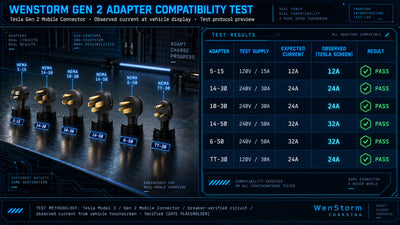
Tesla Gen 2 Mobile Connector: WenStorm's TT-30 adapter is designed for this specific connector. On a suitable 30A, 120V TT-30 circuit, the adapter signals a maximum of 24A continuous charging. The Mobile Connector is required and is not included with the adapter.
WenStorm 32A Level 2 portable charger: Not compatible. It has a fixed NEMA 14-50 plug and is designed for a suitable 240V 14-50 outlet. Do not connect it to TT-30 through a passive plug converter or rely on a vehicle current setting to make that combination safe.
Other EVs and portable chargers: Check the specific EVSE manufacturer's instructions for an approved 120V TT-30 connection and current limit. WenStorm's Tesla Gen 2 adapter does not fit or approve a Ford, Rivian, Hyundai, Kia, Chevrolet, Nissan, Volkswagen, or other portable EVSE. Do not infer a safe charging current from the vehicle's screen alone. If no compatible TT-30 EVSE is available, book a confirmed NEMA 14-50 site for a compatible 14-50 charger or plan another charging stop.
A 30A TT-30 circuit supports no more than 24A of continuous EV charging under the usual 125% continuous-load sizing rule. At 120V, 24A is approximately 2.88 kW before losses. Actual range added varies by vehicle.
TT-30 wiring pinout — what the plug actually is
A TT-30 outlet is a 3-prong NEMA outlet found on RV park pedestals and campground pedestals. Pin arrangement (looking at the face of the outlet):
- X (hot) — angled prong, upper left — 120 V
- W (neutral) — angled prong, upper right — 0 V return
- G (ground) — round prong, bottom center — safety ground
Do NOT confuse TT-30 with:
- NEMA 5-15 — the standard household 3-prong 120 V outlet. Rated 15 A → 12 A continuous. Same voltage but 1/2 the power.
- NEMA 5-20 — a 20 A variant of the standard household plug with one horizontal blade. Rated 20 A → 16 A continuous.
- NEMA 14-30 — a 4-prong 240 V dryer outlet. Physically similar prong count but different voltage. Do not attempt to adapt across.
- NEMA 14-50 — the 4-prong 240 V/50 A outlet standard for Level 2 EV charging. The higher-tier RV pedestal receptacle.
Using the wrong adapter between these outlet types will either not physically connect (correct behavior) or will apply the wrong voltage to the vehicle (dangerous behavior — only possible with fabricated adapters, which is why NRTL-listed adapters exist for every intended combination).
Why the RV pedestal breaker matters as much as the outlet
The pedestal at your campsite has its own 30 A breaker feeding the TT-30 outlet. That breaker is not always ideal — RV parks vary widely in electrical infrastructure age and condition. Two rules to reduce breaker-trip risk:
- Draw only what the breaker can sustain. Stay at or below 24 A continuous. If the breaker trips at 20 A, back off in the car's charging settings (Tesla: Charge screen → decrease amps; Ford: FordPass app → charging limits; most others: in-vehicle charging menu).
- Do not run the RV's own appliances while charging. If the same pedestal feeds your RV's outlets and your EV's charger simultaneously, you can exceed the 24 A budget. Some RV owners split loads to a separate pedestal or shore-power connection.
If you trip the pedestal breaker mid-charge, the resulting reset may reduce your effective charge rate for the rest of the session, and repeat trips can flag maintenance attention from the park operator. When in doubt, start at 16 A and step up.
How Fast Does a TT-30 Charge Your EV? (Real Numbers)
The TT-30 operates at 120V / 30A, which allows EV charging at up to 24A (80% of rated capacity per NEC guidelines).
Charging speed: approximately 7–10 miles of range per hour.
That puts it between Level 1 (2–4 mph) and Level 2 (18–35 mph) — not fast for daily driving, but genuinely useful on a road trip when your car is parked overnight anyway. For a full explanation of the difference, see our Level 1 vs Level 2 charging guide →.
| Charging Source | Voltage | Max Draw | Range Per Hour |
|---|---|---|---|
| Standard wall outlet (Level 1) | 120V | 12A | 2–4 mph |
| TT-30 (RV park pedestal) | 120V | 24A | 7–10 mph |
| NEMA 14-50 (50-amp pedestal) | 240V | 32–40A | 25–35 mph |
| Level 2 wall charger | 240V | 40–48A | 30–44 mph |
What 7–10 mph means on a road trip:
Plug in at 9pm. Wake up at 7am. That's 10 hours of charging — adding 60–80 miles of range while you sleep. If you drove 150 miles during the day and arrived at 25% battery, you'll leave at 45–55% with a comfortable buffer for the next leg.
TT-30 won't give you a full battery every morning. It's not designed to. It's designed to give you enough range to reach the next charge point — whether that's another campground, a Supercharger, or your destination.
TT-30 vs Other RV Park Charging Options
| Option | Speed | What You Need | Notes |
|---|---|---|---|
| TT-30 pedestal outlet | 7–10 mph | TT-30 adapter | Confirm availability at your site |
| NEMA 14-50 pedestal outlet | 25–35 mph | NEMA 14-50 adapter | Present at newer/premium sites |
| Dedicated EVSE at campground | 18–35 mph | EVSE app/card | Rare — fewer than 5% of campgrounds |
| Standard 120V outlet (if available) | 2–4 mph | No adapter needed | Sometimes found at cabin sites |
| No charging | 0 mph | — | Plan your Supercharger stops instead |
Do not assume a TT-30 or 14-50 will be available or permitted at every site. When you find a NEMA 14-50 pedestal, use it — but don't plan your route assuming it'll be there.
How to Plan Your Road Trip Around TT-30 Charging

TT-30 charging changes your road trip math in a specific way: it rewards longer overnight stays and makes every campground night productive for your battery, but it doesn't work as a quick top-up during a lunch stop.
The overnight model:
Plan each driving day so you arrive at the campground with 20–40% battery remaining. After 8–10 hours on a TT-30, you'll leave with 60–80 more miles added. If each day's drive is under 200 miles, this is often enough to keep you comfortable the entire trip without relying on fast chargers.
| Drive Length | Arrive With | TT-30 Overnight (9 hrs) | Depart With |
|---|---|---|---|
| 100 miles | ~50% | +55–65 miles | ~85–90% |
| 150 miles | ~25% | +55–65 miles | ~60–65% |
| 200 miles | ~10% | +55–65 miles | ~45–55% |
| 250 miles | Empty | Not enough — need fast charger first | — |
Rules for TT-30 trip planning:
- Keep each leg under 180 miles if you're relying on TT-30 as your primary overnight charge.
- Arrive before 10pm to maximize charging hours before your morning departure.
- Identify a DCFC backup within 20 miles of each campground — in case the pedestal is occupied or unavailable.
- Carry a NEMA 14-50 adapter too. Many newer campsites have 50-amp pedestals. If you have both adapters, you can take whichever outlet is free and get double the speed when the 14-50 is available.
What Gear to Bring (The Complete Road Trip Charging Kit)
Here's the complete road trip charging kit for a Tesla Gen 2 mobile connector owner:
Essential:
- WenStorm TT-30 Adapter ($69.99) — connects a Tesla Gen 2 Mobile Connector to a compatible TT-30 outlet where EV charging is permitted. ETL certified, built with rugged materials, a 5mm thick cable, corrosion-resistant nickel-plated pins, and a high-quality molded connector — designed for the sustained outdoor load an RV park charging session puts on it. Compact enough to fit in a glove compartment. Confirm a compatible TT-30 outlet and EV-charging permission with the campground before travel.
Strongly recommended:
- WenStorm NEMA 14-50 Adapter — for when the campsite has a 50-amp pedestal. Charges at 25–35 mph vs 7–10 mph. Takes up the same space as the TT-30 adapter in your bag.
Already in your car:
- Tesla Gen 2 Mobile Connector + cable (bring your own; not included with WenStorm's adapter)
- NEMA 5-15 adapter (Level 1, included with Gen 2 kit) — fallback for cabin-style sites with standard wall outlets only
That's the entire kit. The Tesla Mobile Connector is the required EVSE; it handles charging — the adapters just change what outlet it connects to.
Shop the WenStorm TT-30 Tesla Adapter →
For non-Tesla EV owners: the WenStorm Portable Level 2 Charger plugs into NEMA 14-50 outlets but not TT-30. For TT-30 access with a J1772 vehicle, use only an EVSE whose manufacturer explicitly supports a 120V TT-30 connection and appropriate current limiting. Otherwise, reserve a site with a suitable 14-50 outlet for WenStorm's fixed-plug Level 2 charger or plan another charging stop.
Shop All WenStorm Road Trip Charging Gear →
Step-by-Step: How to Charge at an RV Park Tonight
Once you have the adapter, setup is under 60 seconds:
Step 1 — Find the pedestal at your campsite. Look for the grey or brown post at the edge of the site. Confirm the TT-30 slot (3-prong, with two flat blades angled at 45° plus a round ground).
Step 2 — Check if a NEMA 14-50 is also present. If the pedestal has a larger 4-prong outlet (50-amp NEMA 14-50 — all straight blades, no L-shape, physically larger than the TT-30), use your NEMA 14-50 adapter instead — you may charge faster, depending on the vehicle and circuit.
Step 3 — Plug the WenStorm TT-30 adapter into the pedestal. The adapter slides directly onto the TT-30 outlet. No tools. No force required.
Step 4 — Connect your Tesla Gen 2 mobile connector. Plug the adapter end into your mobile connector's adapter slot, then connect the Tesla/NACS charging handle to your car as directed by the Mobile Connector manual.
Step 5 — Confirm charging on your car's display or app. You should see the charge rate — approximately 24A / 2.9kW at 120V. Set a departure time or charge limit if desired.
Step 6 — Unplug in the morning. Disconnect the car first, then unplug from the pedestal. Coil the cable, stow the adapter in your glove compartment, and drive.
Total setup time: under one minute. Total gear required: one adapter that fits in your jacket pocket.
FAQ
What is a TT-30 outlet at an RV park?
A TT-30 (Travel Trailer 30-amp) is the standard 120V/30A electrical outlet on the power pedestal at most RV parks and campgrounds in North America. It has three prongs — two flat blades angled at 45° from vertical (hot and neutral) plus one round ground pin. For EV charging, a TT-30 typically delivers 7–10 miles of range per hour for efficient EVs (Tesla Model Y, Bolt EV, Ioniq 5) and 5–8 miles/hour for larger vehicles (F-150 Lightning, Rivian R1T), useful for overnight charging during road trips.
Can I charge my EV at an RV park?
Yes. Most RV parks have TT-30 outlets on every campsite pedestal. Tesla Gen 2 mobile connector owners can plug in using the WenStorm TT-30 adapter ($69.99, fits in a glove compartment) and charge at approximately 24A / 7–10 mph overnight. Some newer campgrounds also have NEMA 14-50 (50-amp) outlets that charge faster.
How fast does a TT-30 charge an EV?
A TT-30 outlet charges at 120V / up to 24A (80% of the 30A circuit rating), adding approximately 7–10 miles of range per hour. In 9–10 hours overnight, that's 55–70 miles of range recovered. Slower than Level 2, but practical for multi-day road trips where the car is parked overnight at a campground.
Do I need a special adapter for RV park EV charging?
For Tesla Gen 2 mobile connector owners: yes, a TT-30 adapter (like the WenStorm TT-30 adapter, $69.99) is all you need. It plugs into the mobile connector's adapter slot and connects to the campsite pedestal. The adapter requires a compatible Tesla Gen 2 Mobile Connector, which is charging equipment and is not included. Confirm the outlet and campground permission first.
Is TT-30 charging safe for daily use?
TT-30 charging is safe for EV use when using a certified adapter rated for the load. The WenStorm TT-30 adapter is ETL certified, built with rugged materials, a 5mm thick cable, corrosion-resistant nickel-plated pins, and a high-quality molded connector — specifically designed for outdoor use at RV parks and campgrounds. It limits charging to 24A, within the 30A circuit's safe operating range (80% per NEC guidelines).
Should I bring a TT-30 adapter or a NEMA 14-50 adapter on a road trip?
Ideally both. TT-30 availability and EV-charging permission vary by site; confirm both before relying on it. A NEMA 14-50 adapter can provide faster charging when the 50-amp pedestal is available. Both adapters together weigh less than a pound and take up minimal space. For Tesla Gen 2 owners, this two-adapter kit covers essentially every campground and RV resort charging scenario in North America.
Pack the Adapter. Sleep at the Campground. Wake Up Charged.
A TT-30 adapter is one of the most useful pieces of gear a road-tripping EV owner can carry. At $69.99, it pays for itself the first time you skip a $20 public charging session — and it unlocks 16,000+ campgrounds across the US as overnight charging stops.
You don't need a dedicated EVSE. You don't need an app. You don't need to hope the campground installed EV charging. You need the outlet that's already there — and the right adapter to connect to it.
Shop the WenStorm TT-30 Tesla Adapter →
Planning a longer trip and want to cover all outlet types? Use the WenStorm Charging Solution Finder →