EV Charging in Winter: Does Cold Weather Slow Charging?

TL;DR
Yes — cold weather can slow EV charging, but the main limitation is usually the cold battery, not the charger itself. A cold battery temporarily accepts less power while the battery-management system warms the pack; DC fast charging is especially sensitive, while Level 2 AC is usually less affected. Precondition while plugged in so heating comes from the grid, and keep the outlet, plug, and charge port clear of ice and standing water. There is no universal "X% slower" figure — it depends on vehicle, battery temperature, state of charge, and preconditioning.
What Cold Weather Actually Changes
Winter affects several different parts of EV ownership in different ways. Lumping them together into "cold makes charging slower by X%" hides the details you actually need to plan around.
| Winter effect | What actually happens |
|---|---|
| Driving range | Usually decreases because battery efficiency and cabin-heating demand both worsen in cold weather. See range-loss data below. |
| AC Level 1 / Level 2 charging | The EVSE can still supply its rated current, but the vehicle may use some incoming energy to warm the battery or cabin, or temporarily limit acceptance while the pack warms. |
| DC fast charging | Cold battery temperature can materially limit charging power until the pack warms — especially without preconditioning. |
| Regenerative braking | May be reduced while the battery is cold. Tesla explicitly documents this behavior. |
| Preconditioning | Warms the battery and cabin before departure. Doing it while plugged in uses grid energy instead of stored battery energy. |
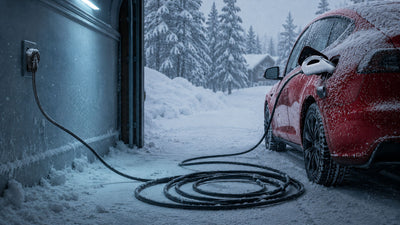
| Charge port & connector | Snow, sleet, and ice can mechanically interfere with the port or latch even when the electrical equipment itself is weather-resistant. |
Tesla explicitly documents cold-battery effects on charging and regenerative braking and recommends leaving the vehicle plugged in with scheduled preconditioning. The U.S. Department of Energy similarly recommends preconditioning while connected and warns that heavy snow and sleet can freeze charging connectors.

How Much Winter Range Actually Drops
Recurrent's 2025/26 winter study analyzed more than 30,000 U.S. EVs across 34 models. On average, those vehicles retained about 78% of ideal-weather range at 32°F (0°C) and about 70% at 20°F (-6°C). Individual models varied substantially — some held closer to 85%, others closer to 60%.

These are range-retention figures, not charging-speed figures. There is no equally useful universal percentage for cold-weather charging speed because charge power depends heavily on battery temperature, vehicle thermal management, preconditioning, state of charge, and whether the vehicle is charging on AC or DC.
Why Preconditioning Matters
Preconditioning warms the battery pack (and often the cabin) to a temperature at which the vehicle can accept more charging power and deliver more driving range. It's the single highest-leverage winter behavior for most owners.
- Do it while plugged in when possible. Energy used to warm the battery comes from the grid instead of the pack. Tesla, Ford, Hyundai, and GM all recommend this pattern.
- Time it for departure. Scheduled preconditioning warms the pack in the last 20–45 minutes before you drive, so you leave with a warm, full battery.
- Precondition before a DC fast-charge session. Many vehicles now precondition automatically when a fast charger is selected in the navigation. If yours does not, plan for a slower first session in cold weather.
Sources: DOE — Winterizing Your Electric Vehicle · Tesla — Cold Weather Best Practices.
Does Cold Weather Actually Slow AC Charging?
The AC EVSE — Level 1 or Level 2 — supplies its rated current regardless of outside temperature (within its own operating range). What can slow apparent charging progress in cold weather is the vehicle: it may use some of the incoming energy to warm the battery, or temporarily limit acceptance until the pack is warm enough to accept full power safely.
What this means in practice:
- Overnight Level 2 charging usually completes normally. Even if the first hour is diverted to warming the pack, the remaining hours restore the state-of-charge target.
- Cold Level 1 charging can genuinely lag. A 120V / 12A supply may not comfortably cover both battery heating and driving-range replacement in severe cold. On the coldest nights, that is when Level 2 clearly wins for daily-mileage drivers.
- DC fast charging is the sensitive one. Cold packs limit fast-charge power heavily until warmed. Preconditioning matters most here.
Can You Charge an EV Below Freezing?
Yes — most modern EVs can charge below freezing when the vehicle and EVSE are being used within their specified operating ranges. Cold weather does not automatically make EV charging unsafe. The battery-management system may reduce charging power or use some energy to warm the battery before allowing higher rates. Exactly what happens depends on the vehicle.
The best winter strategy for most owners is usually to leave the vehicle plugged in whenever practical and use scheduled battery / cabin preconditioning before departure. Tesla specifically recommends leaving the vehicle plugged in so the charging system can help keep the battery warm.
What to Do If the Charge Port or Connector Freezes
Do not force it, and do not use improvised high-heat methods. Follow the vehicle manufacturer's cold-weather or charge-port defrost procedure if one is provided.
For example, Tesla instructs owners experiencing a frozen charge-port latch to use the mobile app to precondition the vehicle on HI for approximately 30–45 minutes, then attempt to connect or disconnect.
If snow, ice, or moisture is inside a wall receptacle or plug connection, do not connect the EVSE until the electrical connection is dry and safe to use. If a receptacle repeatedly trips, shows corrosion, or contains moisture, stop using it and have the installation inspected. Do not pour hot water on charging equipment.
Is It Safe to Charge in Snow or Rain?
EV connectors and charging equipment are designed to be used outdoors within their published environmental ratings. An IP rating tells you what kind of dust and water ingress the equipment is designed to resist under defined test conditions. It is a useful reference point, but it does not by itself say whether every winter setup is safe.

For any outdoor portable EVSE, keep these four things in mind together:
- The EVSE's published IP rating and operating-temperature range — both, not just one
- The manufacturer's installation and use instructions — especially the outdoor and cold-weather sections
- The wall receptacle and outdoor cover — a while-in-use cover, suitable for the location, installed per locally adopted code
- The condition of connectors — clean, dry, and free of ice, snow, or corrosion before connecting
Do not connect a portable EVSE through damaged, wet, or ice-contaminated connections.
What to Look for in a Winter-Use Portable EVSE

If you are shopping for a portable Level 2 charger you plan to use outdoors in winter, five checks matter more than the marketing sticker on the box:
- Published operating-temperature range. Confirm the low end covers the coldest temperature at your location. This is separate from the IP rating.
- Weather rating. IP55 is designed for low-pressure water jets; IP66 for high-pressure jets. Match the rating to your setup, and read the manufacturer's outdoor-use guidance.
- Cable flexibility at low temperature. Some cables stiffen sharply in extreme cold. A rated low-temperature cable is more usable at -20°C than a general-purpose one.
- Safety listing. ETL or UL listing indicates the finished product passed the applicable safety standard for its category.
- How the outlet is treated. Weight and leverage on an unprotected outdoor 14-50 receptacle stress the plug and receptacle. Keep the receptacle in a while-in-use cover and off the ground.
Frequently Asked Questions
Does cold weather permanently damage my EV battery?
No — modern EV batteries are designed to operate through winter. Range decreases in cold weather, and cold packs charge more slowly on DC fast until warmed, but ordinary winter use does not cause permanent damage. Follow the vehicle's recommended daily charge limit and long-term-storage guidance in the owner's manual.
Should I charge to 100% in winter?
Use the charge limit recommended for your specific vehicle and battery chemistry. For a winter road trip, starting with more energy can be useful because cold-weather range is lower; for routine daily charging, follow the manufacturer's normal recommended daily limit.
Level 1 or Level 2 for cold-climate daily driving?
Level 2 is easier in sustained cold because more input power (typically 24A–32A at 240V vs 12A at 120V) means the vehicle can both warm the battery and add driving range in the same overnight window. Level 1 still works for lower-mileage drivers in mild-cold climates, but tight overnight windows in severe cold favor Level 2.
Is it safe to plug in during a snowstorm?
Yes, when the equipment is used within its published ratings and the connections are clean and dry. Do not connect through a receptacle or plug that has standing water, ice, or corrosion. Use an outdoor while-in-use cover on the wall receptacle.
Do I need a higher IP rating for winter?
Higher IP ratings offer more resistance to water and dust ingress, but IP rating alone does not determine winter suitability. Follow the manufacturer's operating-temperature range and outdoor-use guidance, and keep the receptacle protected.
Primary sources used in this guide
- U.S. Department of Energy — Winterizing Your Electric Vehicle — preconditioning, charge-limit guidance, connector freezing
- Tesla — Cold Weather Best Practices — cold-battery charging behavior, keep-plugged-in guidance
- Tesla — Charging Instructions — 30–45 minute charge-port defrost procedure
- Recurrent — Best EV for Winter & Cold Weather Range (2025/26 study, 30,000+ vehicles) — average range retention
- Ford Media Center — preconditioning recommendations
Last verified: 2026-09-10. Product prices and specifications checked on the linked WenStorm product pages on 2026-09-10.