Can a Portable EV Charger Be My Only Home Charger in 2026?
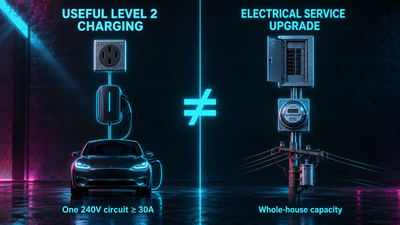
The real decision isn't portable or wall-mounted — it's whether the EVSE, electrical supply, and feature set match your daily charging needs.

TL;DR
Yes. A portable Level 2 EV charger can be your only home charger if the EVSE is properly certified for the application, the outlet and branch circuit are suitable, and its charging power can replace the energy you normally use during your parking window. At 240V and 32A, maximum AC output is about 7.7 kW, so an eight-hour session can supply up to about 61 kWh before charging losses. A wall-mounted charger becomes more useful when you need higher charging power, load management, smart controls, access control, or a hardwired installation. "Portable" describes the charger's form factor — it does not automatically mean slower charging.
Portable EV Charger vs Wall Charger: Which One Should Be Your Primary Charger?
The real decision isn't portable or wall-mounted. It's whether the EVSE, electrical supply, and feature set match your daily charging needs.
| Your situation | Portable Level 2 | Wall-mounted / hardwired |
|---|---|---|
| Suitable existing 14-50 outlet + 32A meets daily needs | Good fit | Optional |
| Need 40A from a suitable 14-50 setup | Possible with compatible equipment | Possible |
| Need 48A / 11.5 kW | Usually not the best fit | Hardwired typically preferred/required |
| Need dynamic load management | Limited by product | Better fit with supported smart EVSE |
| Want scheduling / energy monitoring / remote controls | Depends on portable model | Common on smart wall units |
| Want to take the charger on trips or when moving | Strong advantage | No |
| No suitable 240V circuit/outlet exists yet | Electrical work still required | Electrical work still required |
| Want to avoid a plug/receptacle connection in the permanent setup | No | Hardwired advantage |
The real decision isn't "portable or wall-mounted?" — it's whether the EVSE, electrical supply, and feature set match your daily charging needs.
How to Tell Whether 32A Is Enough for Your Daily Driving
The useful question isn't peak amperage — it's how many kWh the charger can supply during your normal parking window. Use this four-step method:
- Estimate how much energy you normally need to replace each day. A typical passenger EV uses ~0.30 kWh per mile, so 40 miles a day ≈ 12 kWh, 100 miles ≈ 30 kWh.
- Determine how many hours the vehicle normally stays plugged in. Overnight, workday, or split sessions all count — as long as the vehicle actually spends that time connected.
- Compare the requirement with the EVSE's maximum AC output, and allow additional time for charging losses (typically a few percent to ~10%) and vehicle energy use during the session (preconditioning, cabin conditioning).
- Check the vehicle's onboard AC charging limit. A higher-power EVSE cannot make the car accept more AC power than its onboard charger allows.
How much energy fits in one overnight session
These figures are AC energy supplied before charging losses, not guaranteed battery energy. Actual state-of-charge gain will be slightly lower.
| Charging window | 240V / 32A | 208V / 32A |
|---|---|---|
| 6 hr | up to ~46 kWh | up to ~40 kWh |
| 8 hr | up to ~61 kWh | up to ~53 kWh |
| 10 hr | up to ~77 kWh | up to ~67 kWh |
Why Does My 32A Charger Show About 6.6–6.7 kW Instead of 7.7 kW?
Some apartment, condo, and light-commercial buildings have 120/208V service instead of standard 120/240V residential service. In those buildings, a nominal "240V" charging setup may actually supply approximately 208V. That's not a fault — it's the building's electrical service.
At 208V and 32A, maximum AC output is about 6.65 kW instead of 7.68 kW. Over an 8-hour window that's roughly 53 kWh of AC energy instead of 61 kWh — still enough to replace typical daily driving for most passenger EVs, but a real spec difference worth checking on your building's service panel before purchase.
What Must Be True Before a Portable EVSE Becomes Your Everyday Charger?
- Circuit: suitable for the EVSE's continuous charging load and installed according to applicable code and equipment instructions.
- Receptacle: properly rated, undamaged, and appropriate for sustained EV charging.
- Connections: correctly installed and torqued according to the equipment manufacturer's specifications.
- Outdoor use: EVSE and receptacle arrangement must be suitable for the installation environment.
- Local requirements: GFCI, permitting, and installation requirements vary with the adopted code and jurisdiction.
If the history, condition, or suitability of an existing 14-50 installation is uncertain, have it evaluated by a qualified electrician before relying on it for daily EV charging.
When a Portable Charger Should NOT Be Your Only Home Charger
Portable isn't the right choice for every home. Four cases where a wall-mounted or hardwired EVSE fits better:
- You routinely need more charging power than 32A can provide during your parking window. If nightly energy replacement requires 40A or 48A in the available hours, a portable capped at 32A leaves you short.
- Your electrical service requires integrated load management to add meaningful Level 2 charging. Homes near service-panel capacity often need dynamic load balancing that portable EVSEs typically don't provide.
- You need app monitoring, utility integrations, access controls, or other smart features that the portable model you're considering doesn't offer.
- You don't have a suitable outlet or circuit and are installing new electrical infrastructure anyway. If you're paying an electrician to run a new branch circuit either way, compare the total installed cost and benefits of hardwiring before choosing a receptacle purely to support a portable EVSE.
Home Charging Options at 240V — Compared
For this article the key comparison isn't price or amperage — it's "can this replace a wall charger?". Reverify every exact competitor spec on the manufacturer's site before purchase.
| Product | Installation | Max AC output | Portable | Smart controls | Load management | Cable | Warranty |
|---|---|---|---|---|---|---|---|
| WenStorm 32A Portable | NEMA 14-50 plug | 7.7 kW | Yes | No | No | 25 ft | 2 yr |
| Tesla Mobile Connector (Gen 3) | Outlet + adapters | Up to 7.7 kW (with 14-50 adapter) | Yes | Limited / vehicle dependent | No | ~20 ft | Per Tesla policy |
| Emporia Pro (plug-in) | NEMA 14-50 plug | Up to 9.6 kW (40A on 14-50) | Not trunk-focused | Yes | Model-dependent | 25 ft | 3 yr |
| Tesla Universal Wall Connector | Hardwired | 11.5 kW (48A) | No | Yes | Yes | 24 ft | 4 yr |
Verify every exact competitor feature on the manufacturer's current product page before relying on the comparison.
Faster Home Charging — What Actually Goes Above 32A
Going above 32A on a residential circuit typically means:
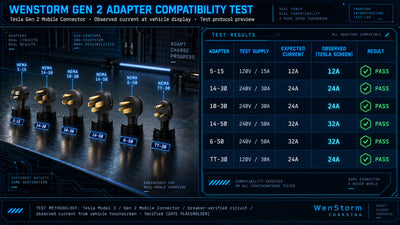
- 40A (9.6 kW): possible on a 14-50 plug with compatible equipment. Some portable EVSEs support 40A on a 14-50 configuration; others cap at 32A.
- 48A (11.5 kW): typically hardwired on a 60A branch circuit. Level 2 EVSEs at this output are usually wall-mounted rather than portable.
Also check your vehicle's onboard AC charging limit — some EVs are capped at 32A / 7.7 kW, others accept up to 40A or 48A. A higher-rated EVSE cannot force the vehicle to accept more AC power than its onboard charger supports.
WenStorm Level 2 Portable — Specifications
The WenStorm 32A NEMA 14-50 portable is designed as a primary home charger for the majority of households whose daily energy replacement fits within an overnight window at 32A. At 32A, it delivers the same 7.7 kW maximum AC output as any compatible EVSE configured to 32A.

What the Handle-Integrated Design Does — and Does Not — Do
The WenStorm 32A portable uses a handle-integrated design (no separate mid-cable control box). Compared with mid-cable-box designs, this can make packing and storing the charger easier in a specific vehicle. It does not change:
- Maximum charging power — that's determined by the amperage rating, voltage, and the vehicle's onboard AC charger.
- Charging speed — form factor doesn't override the vehicle's acceptance.
- Suitability for a specific outlet or circuit — you still need a suitable NEMA 14-50 outlet on an adequate branch circuit.
Compare packed size, weight, and how easily each charger stores in your vehicle. That's the honest apples-to-apples comparison for a portable — not the location of the control electronics.
Frequently Asked Questions
How fast will a 32A portable actually charge my car?
At 240V and 32A, maximum AC output is about 7.7 kW. Actual charging rate depends on the vehicle's onboard AC charger, battery state, temperature, and cabin conditioning. Some EVs are limited to 32A / 7.7 kW or less; others can accept higher AC power but will still be capped by the EVSE at 32A. Use kWh over the parking window, not "miles per hour," to plan.
Can this charger run on a 120V household outlet?
No — the WenStorm 32A NEMA 14-50 model is designed for 240V input on a properly rated 14-50 circuit and does not operate from a standard 120V household outlet. If 120V is your only available supply, use equipment designed and approved for that input, such as a Level 1 (120V) portable EVSE.
Can two EVs share one WenStorm 32A portable?
This WenStorm portable EVSE has one vehicle connector and charges one vehicle at a time. Charging two EVs simultaneously requires another suitable charging setup or compatible load-management equipment. Sequential charging (one after the other) works fine on a single portable.
What does 208V do to my charging rate?
In some apartment, condo, and light-commercial buildings the "240V" supply is actually 120/208V. At 208V and 32A, maximum AC output is about 6.65 kW instead of 7.68 kW — approximately 15% less per hour. Over an 8-hour window that's ~53 kWh vs ~61 kWh. Still workable for most daily driving; worth verifying on the building's service before purchase.
Is 32A enough if I drive a truck or large-battery SUV?
For daily driving, usually yes — the daily energy replacement for most owners fits within an overnight 32A window. If you routinely drive high daily mileage and the parking window is short (or cold weather reduces available energy), a wall-mounted 40A or 48A option adds throughput. Use the 4-step method above with your actual weekly mileage before deciding.
Does the portable form factor hurt reliability?
Portable Level 2 EVSEs are used in millions of home installations. Reliability depends on the specific product's certification, construction, and the suitability of the outlet and circuit — not on portable vs wall-mounted alone. Verify listing information on the product page for your specific model.
Do I need a permit to plug a portable Level 2 into an existing 14-50 outlet?
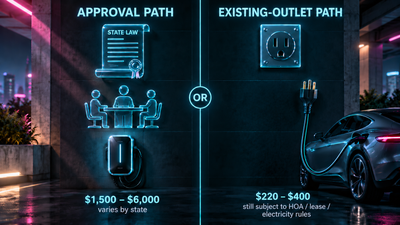
For a portable plug-in EVSE on an existing suitable outlet, typically no. If new circuit or outlet work is required, permits and inspection are often required — check with your local authority having jurisdiction.
Can I install a 14-50 outlet just to use this charger?
Yes, and it's common. Compare total installed cost against a hardwired 40A / 48A option before deciding — if you're paying an electrician to run a new branch circuit either way, hardwiring may deliver more charging power for a small cost delta.
Primary Sources
- U.S. DOE Alternative Fuels Data Center — Electric Vehicles for Consumers — Level 1 / Level 2 / DC fast typical rates, portable EVSE recognition
- U.S. DOE AFDC — Charging Electric Vehicles at Home — continuous-load framing, dedicated-circuit guidance
- WenStorm Certification Center — Intertek ETL listing for the Z7B model to UL 2594 / CSA C22.2 No. 280
- Tesla — Mobile Connector Support — bundle contents, adapter options
- Tesla — Wall Connector Support — 48A hardwired output, app controls, power management
- Emporia Pro — product page — install and continuous-load guidance
Last verified: 2026-09-13. Manufacturer specs and WenStorm Certification Center listings checked on 2026-09-13.